
Is your kitchen showing its age, but the thought of a full-scale renovation-and its hefty price tag-is simply out of the question? You’re not alone. Many homeowners look at their tired cabinetry and think, “If I paint my cabinets, will it actually look good, or just cheap and temporary?” The concern is valid; the difference between a stunning, durable transformation and a peeling disaster lies entirely in the quality of the process and materials.
This guide is designed to put those fears to rest. We are sharing our professional, step-by-step method to help you achieve a flawless, factory-quality finish that revitalises your space and adds real value to your home. You’ll learn everything from the crucial art of surface preparation to selecting the best paint and applying it for a smooth, long-lasting result. By the end, you will have the expert knowledge to either tackle the project with confidence or hire the right painter for the job.
Why Paint Your Cabinets? The Power of a Professional Refresh
A full kitchen renovation is a significant undertaking, both in time and expense. For many homeowners, the existing layout works well, but the cabinets themselves appear dated. This is where the transformative power of a professional paint finish comes in. It offers a sophisticated and highly effective way to modernise your kitchen, enhance your home’s overall aesthetic, and increase its value without the disruption of a complete overhaul.
Choosing to paint my cabinets is one of the most impactful design decisions you can make. A fresh, expertly applied colour can completely alter the mood of the room, making it feel brighter, larger, and more contemporary. It’s a strategic investment that delivers a stunning visual return, allowing you to love the heart of your home once more.
Painting vs. Replacing: A Cost and Time Comparison
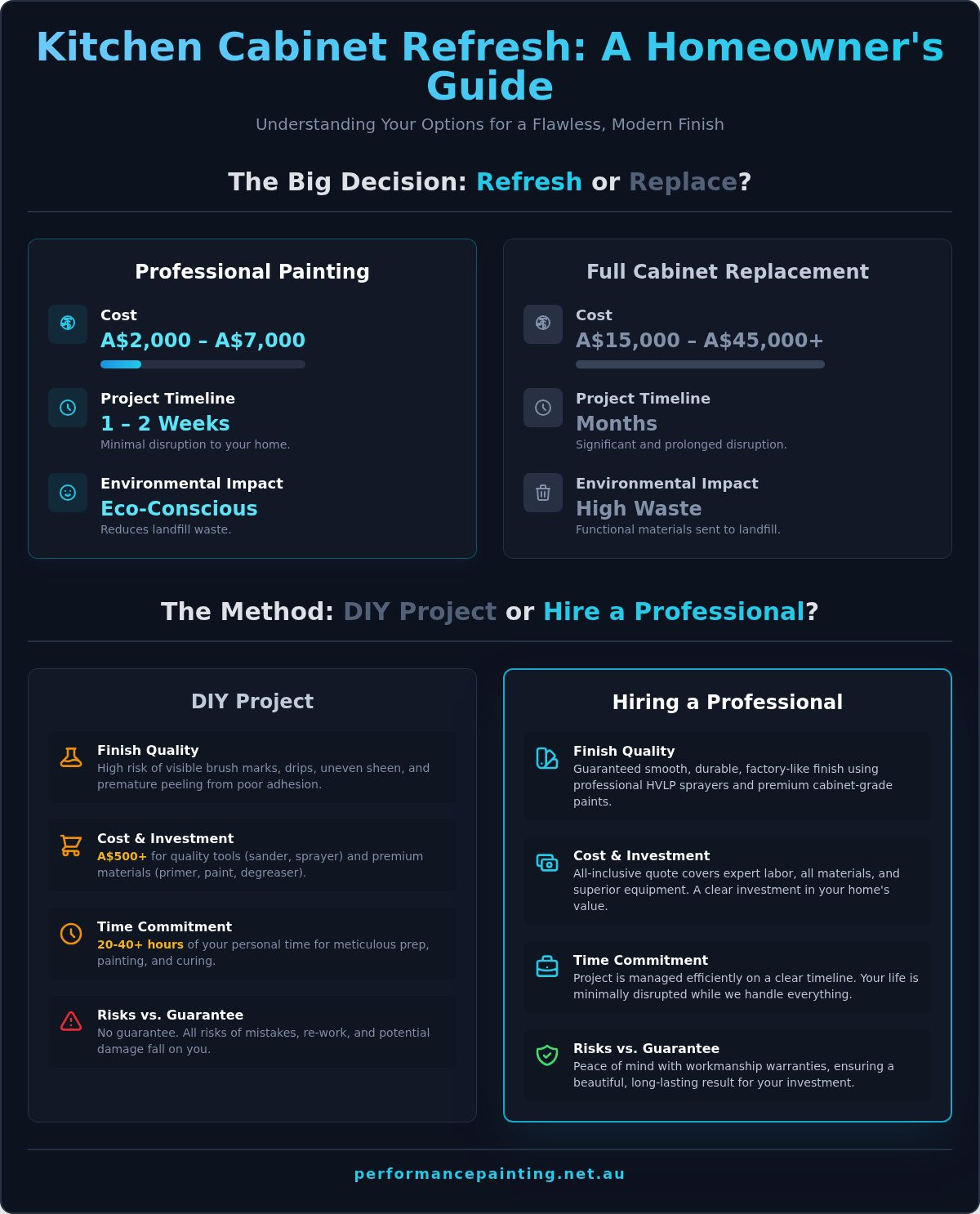
The financial and logistical differences between painting and replacing cabinets are substantial. A professional cabinet painting project in Australia typically ranges from A$2,000 to A$7,000, depending on the size and complexity of your kitchen. In contrast, a full replacement with new cabinetry can easily cost between A$15,000 and A$45,000 or more. The timeline is equally compelling: a professional repaint is often completed within one to two weeks, whereas a full renovation can disrupt your home for months. Furthermore, choosing to refresh your existing cabinets is an environmentally conscious choice, preventing perfectly functional materials from ending up in a landfill.
The Value of a Professional Finish
While DIY painting is an option, achieving a flawless, durable finish on high-touch surfaces like kitchen cabinets requires expert knowledge and specialised equipment. A professional painter understands the nuances of different materials and cabinet construction, ensuring the correct preparation and products are used for a lasting bond. This expert approach guarantees a smooth, factory-like finish that resists chipping, peeling, and the general wear and tear of a busy kitchen. Entrusting the work to a professional provides peace of mind and a guaranteed quality result that elevates your pride in your home.
Even if you’re not in the US, looking at the portfolio of a dedicated service for kitchen cabinet painting denver can provide a benchmark for the quality and results you should expect from any professional you hire.
DIY vs. Hiring a Professional: An Honest Assessment
When considering a kitchen refresh, the thought, “I can save money if I paint my cabinets myself,” is a common and understandable one. While the DIY approach can be rewarding, it’s essential to weigh the full scope of the project against the value and peace of mind that a professional service provides. A flawless, durable finish requires more than just a can of paint and a brush; it demands significant time, specialised tools, and expert technique.
The Reality of a DIY Cabinet Painting Project
The initial cost savings of a DIY project can be misleading once you account for the necessary investments in both materials and time. Achieving a professional-grade result involves:
- Tool & Material Costs: The initial outlay for quality supplies can quickly add up. This includes a power sander, high-quality brushes and rollers, a paint sprayer for a smooth finish, drop cloths, painter’s tape, degreasers, wood filler, and premium primer and paint, often costing upwards of A$500.
- The Time Commitment: Painting cabinets is not a weekend job. Expect to dedicate 20-40 hours to meticulous preparation, painting multiple coats, and allowing for adequate drying time between each step.
- Common Risks: Without experience, it’s easy to end up with visible brush marks, drips, or an uneven sheen. More serious issues like improper paint adhesion can lead to chipping and peeling down the line, negating your hard work.
The Advantages of Hiring an Expert Painter
Engaging a professional team transforms the project from a stressful undertaking into a seamless experience with a guaranteed quality outcome. The value lies in their expertise and efficiency. Professionals provide:
- Superior Equipment: Experts use professional-grade tools, such as HVLP (High-Volume, Low-Pressure) sprayers, to achieve a perfectly smooth, factory-like finish that’s nearly impossible to replicate with a brush.
- Product Knowledge: A seasoned painter understands the best primers and durable, cabinet-grade paints for a high-traffic area like the kitchen, ensuring a finish that withstands daily use.
- Guaranteed Results: A professional service operates on a clear timeline, minimising disruption to your home. More importantly, reputable companies offer workmanship warranties, giving you complete confidence in the longevity and value of your investment.
Seeing what a dedicated professional service entails can be a helpful reference point when making your decision. As an example of a team that specializes in this work, you can learn more about Cabinet Refinishing Boulder and the types of factory-quality finishes that are possible.
Checklist: Are You Ready for a DIY Project?
Before you begin, ask yourself these honest questions to determine if the DIY path is right for you.
- Do you have 20-40 hours available to dedicate solely to this project over the next few weeks?
- Are you comfortable with meticulous, multi-step preparation, including degreasing, sanding, and priming every surface?
- Do you have a separate, well-ventilated space (like a garage) to paint and let cabinet doors cure without dust or disruption?
If you answered no to any of these questions, entrusting the job to a professional is the surest way to achieve the flawless finish your kitchen deserves. To understand the value and quality we can bring to your home, request an obligation-free quote today.
The Professional’s Step-by-Step Cabinet Painting Process
Achieving a durable, factory-like finish on kitchen cabinetry is a science built on a meticulous process. While the final colour is what you see, the true quality of the job lies in the groundwork. At Performance Painting, we believe that expert preparation accounts for at least 80% of the final result. This unwavering commitment to detail is what separates a professional finish from a standard DIY attempt. When homeowners trust us to paint my cabinets, they are investing in a proven system that guarantees beauty and longevity.
Step 1: Meticulous Preparation and Cleaning
The process begins with careful disassembly. Every door, drawer front, and piece of hardware is safely removed and meticulously labelled to ensure perfect reassembly. We then treat all surfaces with a professional-grade degreaser, a crucial step to eliminate years of accumulated kitchen grime, oils, and residues that would otherwise prevent proper paint adhesion. Your kitchen is our priority, so we thoroughly mask and protect all surrounding areas, including floors, benchtops, splashbacks, and appliances, leaving your space clean and undisturbed.
Step 2: Sanding and Priming for Ultimate Adhesion
With a clean canvas, we begin the critical surface preparation. Every cabinet surface is expertly sanded to de-gloss the old finish and create a “key” for the new coats to grip onto. This step is non-negotiable for lasting results. Following this, we apply a high-adhesion bonding primer. This is not just an undercoat; it’s a specialised formula designed to bond powerfully to the substrate, seal the surface, and prevent any stains or wood tannins from bleeding through. This guarantees a uniform, flawless base for the topcoats.
Step 3: Applying the Finish Coats for Durability
The final stage is where the transformation becomes visible. To achieve a perfectly smooth, brush-stroke-free finish, we apply multiple thin coats of premium cabinet paint, often using a professional spraying system. Between each coat, we perform a light sanding to remove any minor imperfections and ensure the next layer is perfectly level. Finally, we allow for proper curing time. While paint may feel dry to the touch in hours, curing is the chemical process where it hardens to its maximum durability, a vital step for a kitchen that will stand the test of time.
Choosing the Right Paint and Finish for Your Cabinets
Selecting the right product is one of the most critical decisions you’ll make when you decide to paint my cabinets. Unlike standard wall paint, cabinet coatings are specifically formulated to withstand the high-touch, high-moisture environment of a kitchen. They must resist chipping, staining, and frequent cleaning. A professional-grade paint provides a hard, durable film that ensures your newly finished cabinets not only look beautiful but also deliver long-lasting performance and value.
Best Paint Types for Kitchen Cabinets
Professionals rely on specialised enamel paints for their superior hardness and finish. Here are the top-tier options we use to guarantee a quality result:
- Alkyd Enamels (Oil-Based): The traditional choice, known for creating an exceptionally hard, smooth surface. However, they come with strong odours (high VOCs), require longer drying times, and can yellow over time, particularly with lighter colours.
- Water-Based Alkyds: A modern hybrid that offers the best of both worlds. These paints provide the hard-wearing durability of an oil-based enamel but with the low odour and easy water cleanup of an acrylic paint.
- Urethane Acrylic Enamel: This is a premium, water-based formula reinforced with urethane for maximum durability. It creates a non-yellowing, highly flexible, and scratch-resistant finish, making it an expert choice for kitchen cabinetry.
Selecting the Perfect Sheen
The paint’s sheen, or lustre, affects both its appearance and its durability. For kitchen cabinets, we recommend sticking to proven finishes:
- Satin/Low-Lustre: The most popular choice for a reason. It has a subtle, soft glow that hides minor imperfections well while still being washable and durable enough for daily use.
- Semi-Gloss: This finish offers excellent moisture and stain resistance, making it incredibly easy to clean. It reflects more light, which can brighten a kitchen, but it will also highlight any surface flaws.
Matte finishes are generally avoided as they can be difficult to clean, while high-gloss finishes show every fingerprint and imperfection, making them impractical for a high-traffic kitchen.
Colour Consultation: Finding Your Palette
The right colour can transform your entire kitchen. Timeless choices like crisp whites, sophisticated greys, and deep blues add lasting appeal and value. When choosing, consider how the colour will interact with your existing lighting, flooring, and benchtops. A shade that looks perfect on a sample card can appear entirely different in your home’s unique light. To ensure a cohesive and stunning result, professional guidance is invaluable. Unsure where to start? Book a complimentary colour consultation with our Hobart experts to find the perfect palette for your home.
Common Cabinet Painting Mistakes and How to Avoid Them
Thinking, “I can just paint my cabinets myself,” is a common starting point for many homeowners. While the ambition is admirable, achieving a durable, factory-like finish requires avoiding several critical pitfalls. These errors can quickly turn a rewarding project into a costly and frustrating ordeal, highlighting the value of professional expertise.
Skipping or Rushing Preparation
The number one cause of paint failure is inadequate surface preparation. Kitchen cabinets accumulate years of grease and grime, which must be completely removed with a quality degreaser. Even the best primer cannot adhere to an oily surface. Likewise, after sanding to create a ‘key’ for the paint, every particle of dust must be meticulously wiped away. Any remaining dust will mix into the paint, creating a gritty, unprofessional texture instead of a smooth, clean finish.
Using the Wrong Paint or Primer
Choosing the right products is non-negotiable for a lasting result. Here’s what can go wrong:
- Incorrect Paint: Standard interior wall paint lacks the durability to withstand the daily wear and tear of a high-traffic kitchen. You need a specialised cabinet enamel designed for hardness and scrubbability.
- Wrong Primer: A high-adhesion or bonding primer is essential, particularly for glossy or laminate surfaces, to prevent peeling down the line.
- Thick Coats: A common DIY error is applying coats too thickly to speed up the process. This leads to unsightly drips, extended drying times, and a soft finish that is easily damaged.
Impatience During Curing
There is a critical difference between paint that is ‘dry to the touch’ and paint that is ‘fully cured’. While a cabinet door might feel dry in a few hours, the paint can take several weeks to harden completely into a durable, scratch-resistant shell. Re-installing doors, handles, and bumpers too early is a guaranteed way to cause chips, smudges, and dents, undoing all your hard work. A professional painter will provide a clear curing timeline to protect your investment.
Successfully navigating a cabinet painting project means understanding that precision and patience are key. These common mistakes are precisely what a professional team is trained to avoid. For a guaranteed flawless finish that enhances your home’s value, entrusting the job to our experts is the surest path to success.
Elevate Your Kitchen with a Professional Touch
Painting your kitchen cabinets is a powerful way to revitalise the heart of your home, adding significant value and appeal. As we’ve covered, the secret to a flawless, long-lasting result lies in meticulous preparation and the use of professional-grade materials. While the thought, “I can paint my cabinets myself,” is common, achieving a truly durable, factory-smooth finish requires an expert’s touch.
For over 30 years, Performance Painting has provided this expertise to homeowners throughout Hobart. Our reputation is built on quality, as evidenced by our numerous 5-star Google reviews from satisfied homeowners and our unwavering commitment to using only premium paints. We don’t just paint cabinets; we deliver a lasting, high-quality finish that transforms your space.
Ready for a stunning kitchen transformation? Get your free, no-obligation quote from Performance Painting today. Let us help you create a kitchen you will be proud of for years to come.
Frequently Asked Questions About Cabinet Painting
How long does it take to professionally paint kitchen cabinets?
A professional cabinet painting project for an average-sized kitchen typically takes between 4 to 7 days. This timeline allows for our meticulous process, including thorough cleaning, surface preparation, priming, and the application of multiple quality topcoats. Larger or more complex kitchens may require additional time to achieve the flawless, durable finish that adds lasting value to your home. We provide a tailored project schedule with every quote.
Is it possible to paint laminate or melamine cabinets?
Yes, it is absolutely possible to paint laminate and melamine cabinets with expert preparation. These non-porous surfaces require specialised techniques, including scuff sanding and the application of a high-adhesion primer. This critical first step creates a strong bond for the topcoats, preventing peeling and ensuring a durable, long-lasting finish. Our team has the expertise to correctly prepare and transform these challenging surfaces, giving them a new lease on life.
How durable is a professional cabinet paint finish?
A professionally applied cabinet finish is exceptionally durable and designed to withstand the daily demands of a busy kitchen. We use premium, hard-wearing paints specifically formulated for cabinetry, which cure to a tough, scrubbable surface. Our rigorous surface preparation process is key to this longevity, ensuring superior adhesion that resists chipping and wear. With proper care, you can expect your beautiful new cabinet finish to last for many years to come.
How much does it cost to have my kitchen cabinets painted in Hobart?
The cost to professionally paint my cabinets in the Hobart area typically ranges from $2,500 to $7,000 for a standard-sized kitchen. The final price depends on several factors, including the number of doors and drawers, the current condition of the cabinets, and the type of finish selected. We provide a detailed, obligation-free quote that outlines all costs, ensuring you receive a transparent and accurate price for a quality, long-lasting transformation.
Do I need to empty my cabinets before you start painting?
Yes, we do require that you empty your cabinets and drawers before our team arrives to begin work. This is an essential step to protect your dishes, food, and other belongings from dust and paint. It also allows our painters to have unobstructed access to all interior edges for the most complete and professional finish possible. Clearing them beforehand helps us work efficiently and ensures a clean and seamless project from start to finish.
What is the best way to clean my newly painted cabinets?
To care for your newly painted cabinets, we recommend gentle cleaning methods. For everyday marks, use a soft, damp microfibre cloth with a small amount of mild dish soap and water. Wipe gently and dry the surface immediately with a separate clean cloth. Avoid using abrasive sponges, harsh chemical cleaners, or ammonia-based products, as these can damage the integrity and sheen of the professional paint finish over time.