
Planning to refresh your Australian home with a new coat of paint is an exciting prospect, but it often comes with one major question: how much will it actually cost? Trying to budget can feel overwhelming, with the risk of unexpected expenses and confusing quotes. While a simple online painting cost calculator australia might provide a starting figure, these tools rarely capture the full picture of what’s involved in achieving a truly professional result that adds lasting value to your property.
Hiring an experienced painter provides value that extends far beyond simply applying paint to a wall. You are paying for a guaranteed, high-quality result that protects your investment, a principle that applies to other valuable assets as well. For example, the same level of care is offered by premier automotive facilities like Carzzone Auto Service to protect and enhance a vehicle’s value. The benefits of hiring a professional for your home include:
This professional guide is designed to give you clarity and confidence. We will break down the key factors that truly determine painting costs in Australia, from the size of your space and the condition of the surfaces to the quality of materials used. You will learn what a comprehensive quote from an expert painter should include, how to budget accurately for a high-quality finish, and how to make an informed decision for your home. Let’s move beyond guesswork and ensure your investment enhances your home’s appeal and value for years to come.
Beyond the Calculator: What Truly Determines Painting Costs?
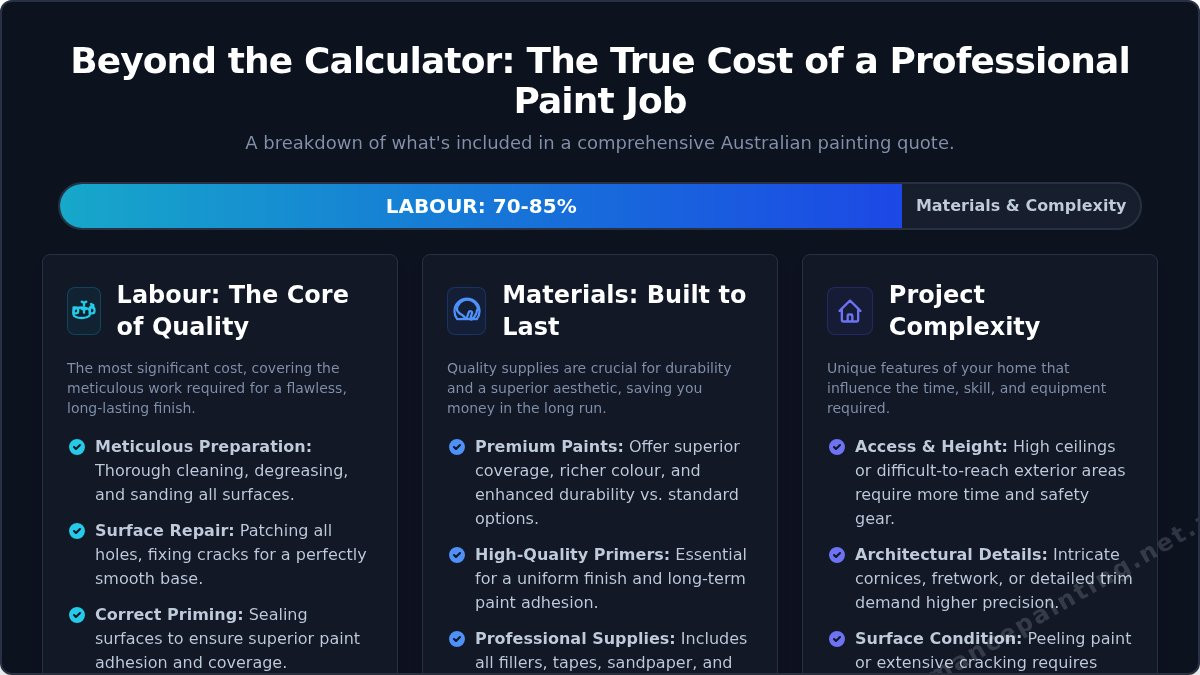
An online painting cost calculator australia is an excellent tool for getting a preliminary budget in mind. However, these tools can’t see the unique details of your property. The final, accurate price of a professional paint job is determined by a combination of factors that go far beyond simple square meterage. To truly understand your investment, it’s essential to look at the three core components: labour, materials, and project complexity. This knowledge will not only help you interpret a quote but also distinguish a comprehensive proposal from a vague, and potentially costly, estimate.
Labour Costs: The Biggest Factor in Your Quote
Labour is the most significant part of any professional painting quote, typically accounting for 70-85% of the total cost. This isn’t just for the time spent applying paint; it covers the meticulous and time-consuming preparation that ensures a lasting, high-quality finish. This expert work includes:
- Thorough cleaning and degreasing of all surfaces.
- Sanding, patching holes, and repairing cracks for a perfectly smooth base.
- Applying the correct primers to seal surfaces and ensure paint adhesion.
- The skilled application of multiple coats, including precise work on trim, windows, and doors where the expertise of a professional house painter and decorator truly adds value.
Material Costs: More Than Just Paint
While paint is the obvious material, the quality and type of all supplies directly impact the final result and its longevity. A professional quote will factor in premium paints that offer superior coverage and durability compared to standard options, saving you money on future repaints. It also includes all necessary supplies like high-quality primers, fillers, sandpaper, professional-grade painter’s tape, and protective drop sheets. For specific jobs, specialised coatings for surfaces like roofs or concrete may also be required.
Project Complexity and Surface Condition
Every home is different, and complexity plays a major role in the time required. Factors that increase labour time, and therefore the cost, include high ceilings, intricate architectural details like cornices or fretwork, and areas with difficult access. Furthermore, the existing condition of your walls is critical. Surfaces with peeling paint or extensive cracking will demand significantly more preparation work. A dramatic colour change, such as from a dark red to a light white, will also necessitate extra coats to achieve a perfect, even finish.
How to Estimate Your Project: A Step-by-Step Guide
Before you can budget for your project, you must first understand its full scope. A precise estimate relies on accurate measurements and a clear list of what needs painting. This step-by-step guide will help you gather all the essential information required for any online painting cost calculator australia or a detailed discussion with a professional painter. By preparing these figures for both interior and exterior surfaces, you streamline the quoting process and ensure you receive a fair and accurate price for the quality finish your home deserves.
Measuring Your Interior Spaces
To calculate the paintable surface area inside your home, you’ll need a tape measure and a notepad. Taking the time to be precise here will result in a much more reliable cost estimate. Focus on these key areas:
- Total Wall Area: For each room, measure the length and width. Use the formula: (length + width) x 2 x ceiling height.
- Ceiling Area: Simply multiply the room’s length by its width (length x width).
- Doors & Windows: Note the total number of doors (and door frames) and windows that require painting. Professionals often price these per item.
- Trim Details: Measure the total length in metres of any skirting boards, architraves, cornices, or picture rails to be painted.
Calculating Your Home’s Exterior
Estimating your home’s exterior involves measuring the overall structure and noting the different materials and architectural features. This information is crucial for determining the right type of preparation and paint.
- Main Wall Area: Measure the entire perimeter of your home and multiply it by the height from the ground to the eaves.
- Gables: For any triangular gable ends, measure the base and the height, then use the formula: (base x height) / 2.
- Surface Type: Identify the primary material. Is it weatherboard, brick, render, fibro, or something else? Different surfaces require different preparation techniques and paint quantities.
- Other Elements: List all other components that need painting, such as eaves, fascia boards, gutters, downpipes, external doors, and window frames.
Accounting for the Number of Coats
A quality, long-lasting finish is rarely achieved with a single coat of paint. The number of coats directly impacts the total cost through labour and materials. A professional standard typically includes one coat of a suitable primer or undercoat followed by two top coats. This ensures exceptional colour depth, durability, and a smooth, even finish. Be aware that significant colour changes (e.g., from dark to light) or painting new, porous surfaces like fresh plasterboard may require an additional coat for a flawless result.
Interior vs. Exterior Painting Costs: Key Differences
Understanding the final figure on your painting quote begins with a simple truth: painting the outside of your house is a fundamentally different task to painting a bedroom. While both enhance your home’s appeal, exterior projects demand more durable materials, extensive preparation, and specialised equipment. Recognising these distinctions is crucial for setting a realistic budget and for interpreting the estimates provided by any painting cost calculator Australia.
Factors Driving Interior Painting Costs
The cost of refreshing your home’s interior is influenced by several key variables that affect both time and materials. A professional quote will always account for:
- Scope of Work: The number of rooms and their size is the primary cost driver. Painting a single feature wall will be significantly less than a full three-bedroom home.
- Complexity and Detail: Intricate work on trim, such as skirting boards, architraves, cornices, and doors, requires more time and precision than rolling paint on a flat wall. Ceilings also add to the overall scope.
- Preparation: A quality finish depends on meticulous preparation. This includes the labour needed to move furniture, protect flooring and belongings with drop sheets, and carefully mask off areas not being painted.
- Paint Choice: Different surfaces require different products. Walls typically receive a low-sheen or matte finish, while trim and doors need a more durable semi-gloss or gloss paint, which can vary in price.
Factors Driving Exterior Painting Costs
Protecting your home from the elements is a larger investment due to the challenging nature of the work. The higher cost is directly related to the labour and resources required to ensure a long-lasting, protective finish. For a detailed breakdown of what drives the cost to repaint house in Australia, including exterior-specific factors, our comprehensive 2026 guide covers everything you need to know.
- Intensive Surface Preparation: This is the most critical stage. It often involves high-pressure washing to remove dirt and mould, scraping and sanding failed or peeling paint, and priming bare surfaces to ensure proper adhesion.
- Weather-Resistant Materials: Australian conditions demand premium, durable paints formulated to withstand harsh UV rays, rain, and temperature fluctuations. The specific product choice is often dictated by your local climate, from coastal salt spray to Hobart’s cooler temperatures.
- Accessibility and Safety: The height of your home is a major cost factor. Multi-storey properties require scaffolding, elevated work platforms, or specialised ladders to be worked on safely and efficiently. The expertise needed for this work is why industry bodies like Master Painters Australia champion the use of fully insured and licensed professionals.
- Cladding Type and Condition: The material on your home’s exterior impacts the labour involved. Preparing and painting detailed timber weatherboards, for example, is more time-consuming than painting a smooth, rendered wall in good condition.
DIY vs. Hiring a Professional Painter: A Cost-Benefit Analysis
When planning a project, the initial sticker price of DIY painting seems undeniably attractive. You buy the paint and a few brushes, and you’re set, right? The reality, however, is often more complex and costly. To make an informed decision, it’s essential to look beyond the initial quote and analyse the true value you receive. A professional paint job is more than just a coat of colour; it’s a long-term investment in your property’s appeal and durability.
The Hidden Costs of DIY Painting
While a basic painting cost calculator Australia might tally up paint tins and rollers, it rarely accounts for the full scope of a DIY project. The true expenses quickly add up when you consider:
- Equipment and Materials: Beyond paint, you’ll need quality brushes, rollers, trays, drop sheets, painter’s tape, sandpaper, and fillers. For a quality job, you may also need to purchase or rent ladders, scaffolding, or even a power sander. These items can easily add hundreds of dollars to your budget.
- The Value of Your Time: A single room can consume an entire weekend. A whole house can take weeks of evenings and holidays. Your personal time has value, and a lengthy DIY project can be a significant drain on it.
- The Cost of Mistakes: Drips on flooring, uneven patches, or accidental paint on window frames are common DIY errors. Rectifying these mistakes can be time-consuming and, in some cases, require hiring a professional to fix, negating any initial savings.
- The Quality of the Finish: Achieving sharp, clean lines and a smooth, durable finish is a skill honed over years. A subpar DIY finish can detract from your home’s aesthetic and may need redoing much sooner than a professional job.
The Value of a Professional Service
Hiring an experienced painter provides value that extends far beyond simply applying paint to a wall. You are paying for a guaranteed, high-quality result that protects your investment. The benefits include:
- Expert Surface Preparation: Professionals understand that a flawless finish starts with meticulous preparation. This includes proper cleaning, sanding, and priming, which ensures the paint adheres correctly and lasts for years.
- Efficiency and Speed: An expert team has the experience and equipment to complete the job in a fraction of the time it would take a DIY-er. They minimise disruption to your home and deliver a finished product on schedule.
- Insurance and Guarantees: Reputable painting services are fully insured, protecting your property from accidental damage. They also provide warranties on their workmanship, giving you complete peace of mind.
Instead of spending weeks on a project with an uncertain outcome, invest in a flawless, lasting finish that enhances your home’s value. Get the job done right with our expert Hobart painters.
From Estimate to Exact Quote: Why a Calculator Isn’t Enough
An online painting cost calculator is an excellent tool for initial budgeting. It provides a valuable ballpark figure based on general inputs, helping you understand the potential investment for your project. However, this digital estimate is just the first step on the path to a beautifully finished home.
To move from a broad estimate to a fixed, reliable price, a professional painter must assess the property in person. This crucial step protects you from unexpected charges down the line and ensures absolute clarity on the scope of work. It’s the only way to guarantee the price you are quoted is the price you will pay for a quality, lasting finish.
What a Professional On-Site Quote Involves
A reputable painting contractor doesn’t just guess. Their on-site assessment is a meticulous process designed to capture every detail that a painting cost calculator australia cannot. This typically includes:
- A thorough inspection: Examining the condition of all surfaces to be painted, from walls and ceilings to trim and doors, to identify any issues.
- A detailed discussion: Understanding your desired outcomes, colour choices, and the type of finish you want to achieve.
- Identifying necessary repairs: Noting any cracks, holes, or water damage that requires professional preparation before a single drop of paint is applied.
- Precise measurements: Taking exact measurements and assessing any access requirements, such as high ceilings or difficult-to-reach exterior walls.
Your Obligation-Free Quote from Performance Painting
At Performance Painting, we believe in complete transparency. Following our on-site visit, we provide a detailed, written quote with no hidden fees, so you can make an informed decision with confidence. Our quotes always include a full breakdown of labour and material costs, outlining every step of the process. With over 30 years of experience serving Hobart and surrounds, our expert assessment ensures your quote is both accurate and competitive.
Ready to transform your property with a flawless finish? Book your free, accurate on-site quote today.
Beyond the Calculator: Securing a Professional Quote
As we’ve explored, a painting cost calculator australia provides a valuable starting point for budgeting your project. However, the true investment in your property’s value and appeal lies in the details that online tools can’t assess-factors like meticulous surface preparation, the quality of materials used, and the unique requirements of your home. Understanding this difference is the key to moving from a rough estimate to a reliable, fixed-price quote.
For a quote that reflects true quality and lasting value, trust the experts who have served the Hobart community for over 30 years. At Performance Painting, our reputation is built on countless 5-star Google reviews and a commitment to excellence. We don’t just provide a price; we offer a comprehensive service that includes expert colour consultation to ensure a perfect finish.
Ready for an accurate price? Book your obligation-free quote with our Hobart experts.
Take the next step towards a beautiful, lasting finish for your home.
Frequently Asked Questions
How much do painters charge per square metre in Australia?
In Australia, professional painters typically charge between A$15 to A$45 per square metre for interior walls. The final price depends on the surface condition, the number of coats required, and the complexity of the job. Ceilings, doors, and trim will often be quoted at a higher rate due to the detailed work involved. For a precise estimate tailored to your home, it’s always best to request a detailed, on-site quote from an expert.
What is a reasonable price to paint a 3-bedroom house interior?
A reasonable price to paint the interior of a standard 3-bedroom house in Australia generally falls between A$4,500 and A$9,000. This range accounts for painting walls, ceilings, doors, and trim. The total cost is influenced by factors such as the home’s total square meterage, ceiling height, the condition of the existing surfaces, and the number of colours chosen. A comprehensive quote will provide a clear breakdown of these costs.
Does the brand of paint significantly affect the total cost?
Yes, the brand of paint does affect the total cost, but labour remains the largest expense. Premium quality paints from brands like Dulux or Taubmans may cost more per tin, but they offer superior coverage, durability, and a better finish. This can reduce the labour time needed for extra coats and extend the life of your paint job, providing greater long-term value and protecting your investment in your property’s aesthetic.
How can I reduce the cost of hiring a professional painter?
To reduce costs, you can undertake some of the preparation work yourself. This includes moving all furniture to the centre of the room, covering it securely, and removing all wall hangings. Ensuring surfaces are clean and free of dust can also save time. Scheduling your project during the painter’s off-peak season, such as winter, may also result in a more competitive quote due to lower demand for their services.
What is typically included and excluded in a standard painting quote?
A standard quote typically includes labour, all paint and materials (such as tape, rollers, and drop sheets), minor surface preparation like filling small holes, and a thorough clean-up after the job. Exclusions often involve significant wall repairs (e.g., major plastering), moving heavy or delicate furniture, and extensive mould treatment. A quality quote, unlike a simple painting cost calculator Australia, will clearly itemise all inclusions and exclusions for complete transparency.
How long should a professional exterior paint job last?
A high-quality exterior paint job, when completed by a professional using premium materials, should last between 10 to 15 years in Australia. The longevity is heavily dependent on the quality of the surface preparation, the number of coats applied, and the local climate. Homes in harsh coastal or high-UV environments may require more frequent repainting to maintain their protective barrier and visual appeal, ensuring the property’s value is preserved.